Wednesday, 4 February 2015

THRILLER BUILDING

CHARACTERS
Noami Lowe (12), was murdered by Trent Haywood (22) and her brother (Elijah) set out to kill him in revenge. Elijah's gruesome killing leaves Trent so disfigured that he is unrecognisable. As there is no evidence, Elijah is not charged and let go. The film's plot depicts the investigation needed to find who the killer actually is. Detective Gareth Cox leads the investigation but he seems to miss all the major events.

In the two minute sequence, we will show the interrogation of Elijah and focus mainly on lighting and setting. Elijah will state where he was at certain times, then show a flashback of him disposing the body.

Detective: Gareth Cox
Rapist: Trent Haywood
Killer: Elijah Lowe
Child: Naomi Lowe (Not being shown in the opening, only mentioned)
  • We are currently in talks about we want to act in our opening sequence - Holly has suggested her dad to be involved as his occupation is within the police force. We could use a voice-over/over casting shadows if he isn't comfortable with showing his face.
  • Naomi won't be shown in the opening sequence, but it's important to include her name for finer details. If we were to make a full-length feature film, we could possibly use flashbacks of her.
  • For Elijah, we need to consider the actor's age - as all of us are in college, we all have fairly young faces. Meg has older friends, so we can take this into consideration.

HAIR & MAKEUP
Meg has shared her interest in special effects make-up, and would like to lead in this role. This will include dried blood, and white-washing dead people's faces. Meg would like to experiment with liquid latex to create acid burns/disfigurements. We to ensure we don't make the disfigurements too gory, otherwise that will make our opening sequence a horror.


LIGHTING & COLOUR
We are going to use the same lighting and colour of most thriller films - darker, and desaturated colour. We also want to cast quite harsh shadows/use gobos. These are all just brainstorming ideas at the moment, and later posts will show our experiments.


PROPS
We will not require many props in the sequence, We will need a folder to act as if it is a file of the murder, in order for the detective to ask questions. Another prop we will need will be a 'shard of glass' which will be used as the murder weapon.


LIGHTING AND COLOUR
In order to create the mood of tension we will be using low unsaturated dark lighting with bright lights on faces to emphasise expression, we will be using desaturated dull colouring to create the atmosphere and leave the audience asking questions.


Monday, 2 February 2015

THRILLER PRE-PLANNING

We began planning our Thriller today. Holly is currently in talks with her dad to get access to a police interviewing room. Meg is also talking to her sister's boyfriend who's profession is to fix broken lifts. Alex has emailed Crawley County Mall for permission to use the back hallways, and for use in industrial lifts. At the moment, we are toying with locations and working on a plot.

Attached below is the email Alex sent to the County Mall - we are currently waiting for a reply.


Our current inspiration is coming from 'Usual Suspects' - we liked the interview at the end of the opening scene. We were also interested in following a 'Disappearance of Alice Creed'/'Prisoners' storyline, showing the abduction of an innocent person.

Now we are interested in including a schizophrenic/sleep-walking character to make the most out of the Thriller genre.

THRILLER RESEARCH: Meg

CABIN IN THE WOODS
The opening sequence of this film is actually very casually presented if you were to look contextually at it. 

However, it is not obvious whether or not this is a point of view (P.O.V) shot or not from the first frame. The costume of the lady standing in the window frame is a top and knickers. This gives us some context as to the fact she is getting ready for something. The mid long shot (MLS) helps us distinguish where our character is and what point in the day it is.  
We then have a straight cut. This is to make the audience aware that we are now in the house that our character is in.The mid close up shows us as an audience little details like the window frame and the setting outside of it. Also we find a little more about our character by the props in the background.


This sequence is a made up of an eye line match on a prop. This is to leave suspense and raise the enigmatic tension between our audience. ("What is she looking at?" "What is the book for?")
I like the way the camera is directed from a low angle in the first shot, this almost suggests the character has a matter of importance, or has found something that beholds importance. This shot is particularly good because it shows the prop of the book at the corner, its almost like a point of view from the book itself.


It then switches to the back of the character, and then she turns around showing us the prop she has just recently made an eye line match with.This is all captured with a Mid shot. This is effective because you can see her movement fully, as well as the setting behind her. This looks like a bedroom, and this shot type shows the audience that.

We then come across the object (prop) in a much closer proximity than when our character was looking at it. this isnt quite a point of view shot because we can see her hair in the right side of the screen. However, we are looking at what she is looking at. This is to give the consumers a real idea of what it's like to be in our characters shoes. Again its raising a lot of questions. This shot is at a slight high angle which could show importance to the drawing, but it is also showing character movement once again. Our character moves her hand over to the rings of the book, almost stroking it. This shows that our character is intrigued, but without this information, as an audience we would be completely clueless as to what she is looking at.
During this sequence, we hear diagetic sound, music. 

We are then introduced to another female character which then means there is more diagetic sound, dialogue. The new character now has the piece of paper from the book, this could suggest they have a close friendship. They are also close in the frame, the mid shot shows us more about the room they are in, we are now able to see a bookcase. Our original starting character likes books, this is evident through the shot types, letting the audience in on our characters lives.


Right at the end of our opening sequence we are again introduced to two other characters. As an audience we are now taken into a different place with our characters. The medium long shot here shows very well the setting of where they are. It seems like a friendly neighborhood. We can see they are in a street or on a main road, as we can see trees, cars, and a pavement/road. This shot type however, doesn't give a very clear imput of the emotions of these characters, which is probably not important at this point. We can take a hunch that someone is leaving as the props are shown very clearly in our male characters arms. 

The lighting in all of these frames are very naturalistic. Realistically, with horrors you tend to have dark and dingy lighting, lots of grey, but as i said at the beginning, it is a very casual opening. You wouldn't begin to watch this movie thinking it is the genre it is. But, maybe that is the directors aim, leaving the audience to have the unexpected to deal with.

The titles are all in red. Red is symbolic for a lot of things, blood, horror, gore, sex, love, danger. A very often used colour in the thriller/horror industry.


PULP FICTION
The opening of this starts with a two shot, with dialogue being the diagetic sound. The shot distance isn't particularly close to our characters, but it is however close enough to notice the context of where they are. 

The body language of our female character is very different to the males. The lady has a very good posture with a straight back and elbows off the table, and our male character is leaning back, in a very relaxed position smoking, inside. The fact he is smoking in a diner (as I suggest it is a diner), you can tell how things have changed in the present. The blinds behind them also tell the audience the time of day, in this case the daytime. There is also diagetic sound in the background as well as the dialogue, of the cars going passed the window they are sitting by and the quiet music playing in the diner.


A shot reverse shot is introduced when the characters are speaking of more important information. It's almost a way to get the audience to lean their heads in with our male character and listen closely to what they both have to say. It definitely raises the enigma in the scene as we are clueless to what they are speaking about. They know more than the audience does. This suggests so far about the two film openings I've analysed so far, that there isn't much dramatic irony in the opening sequence of a thriller.


I would say this shot is a more of an establishing shot. As it's an over the shoulder shot from our male character, we can see further onto the table as the camera is at a slight high angle, this just makes the mise en scene for the audience (props) a little easier to notify. We can also see the facial expression from our female character a lot clearer than before.
As an audience we can't quite tell by looking at these characters if they are protagonists or antagonists. There costume and hair are all very normal and average and nothing gives any signs away. But if you were to listen to the dialogue they speak of robbing a bank, but that still raises the enigmatic side of media, because as an audience we are unaware as to why they would do so.


 There was a match on action here. Our character gets his prop, which is a gun, out of his pocket and places it on the table, with some force, causing a chinking sound as it was placed. 

This was used to show the audience what he was pulling out of his pocket so quickly. 


We are then introduced to the idea that these two characters share a very close proximity which as an audience we were oblivious to at the beginning. This close up shot lets us all up close and personal to the characters giving up a wider idea of how close they actually are and the emotions they are feeling.

Most of the shot types in the beginning are the same, which suggests as an audience it is made to me enigmatic for us. 


THE WOMAN IN BLACK 
(Andrew: you could argue it is a horror and not a thriller, but it came up as a thriller on google search, so apologies if its not a thriller and is actually classed as a horror)

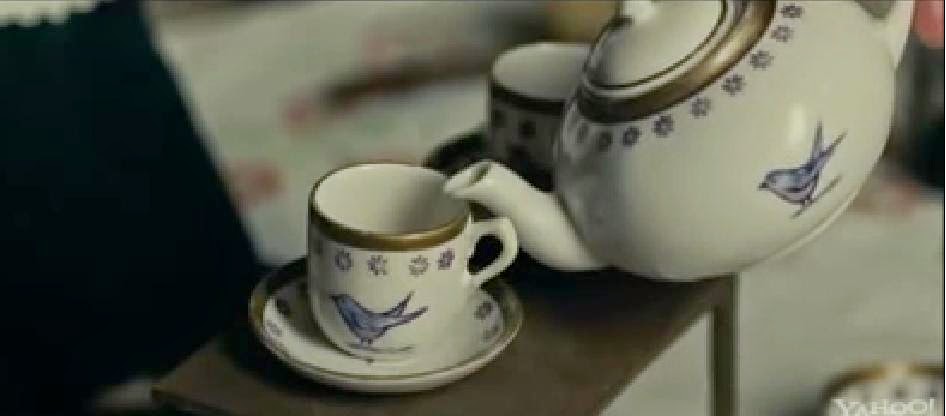
The first shot is a medium close up of a very antique kettle and tea cup set. The use of these old looking props is to set the time back years and to make the audience feel it is real. 

The lighting appears to be a lot dimmer, this gives a good creepy affect, along with the non-diagetic soundtrack that is three notes repeated, of a child lullaby like tone, but disorientated, which is played throughout the 2 minute opening sequence.

We are then introduced to a three person shot, at a mid shot angle. This angle is good because it enables the audience to see the setting more clearly. The props used give a very authentic olden day tea party. TThe children's costumes are very precise and well made, making them look like very good kids.
For example, when we see an extreme close up of the girl tucking in one of her toys, we notice floral pattered sleeves, a shirt is often worn to be smart.
 A mid close is then shown to show the expressions on the children's faces. They seem very happy, and enjoying themselves.
Coming back to the costume element, their hairstyles are both tied back, out of their faces, this really enables us to see their costumes very well.
 
This is a very slight high angle shot, showing the rest of the room and the composition of it that we could not see before. We can now see three windows, which really tie the feel of an old room together. The lighting also helps with showing that this is from the past. None of the props give any signs of our modern day society, right down to our characters' hairstyles, costumes, and the rug on the floor, and even the dolls.


 This sequence raises the enigma rapidly. The non-diagetic music speeds up, and we are asking questions as to what they're staring at, what is so important about those windows.
 The close up of a characters shoes and then the cup she is holding is significant because it is going into great detail about who they are personally. They don't look like particularly new shoes which could suggest their wealth if you was to look at it contextually.
 The character then actually drops the teacup and it smashes onto the group causes a match on action to occur [I'm not sure where this screen grab has gone].

 We then see two trio shots, one from the front - mid shot, and one from behind - medium long shot. This ultimately means that the audience is able to follow their every move.
 This is a continuous shot of them opening the window with the handle. The sound is all very disorientated at this point, especially with the soundtrack we heard at the start of the two minutes is building. 

The sequence then ends on this frame being panned out, and then we hear a diagetic scream (but is all off screen at this point) and then the dialogue "My babies". This works well because we can't see this motherly figure but we are already picturing what has happened and her reaction.

Thursday, 29 January 2015

THRILLER RESEARCH: Alex

USUAL SUSPECTS

This film's opening shows a male character sitting on the ground, soaked, and surrounded by fire; looking quite carefree about the situation. Already, we are asking a lot of questions, making the film enigmatic and appropriate to the theme of 'Thriller'. We are then shown another character, but his face is never actually revealed - again, raising questions for the audience. The camera has been set up specifically like this to create a certain mystery for the remainder of the film.
As this is a film, the fire is controlled - however, this particular trail of fire is significant to the reveal of a new character. To prove it's significance, the camera tracks the fire across the ground until it is dowsed by our mystery man - using his own urine. This dowsing of the fire can be interpreted as mockery - he is in control.

In figure 2, we are shown our original character making direct eye-contact with the unknown man. As the two are at different levels, an eye-line match is used to differentiate where they are in the room, and to suggest one-another's power in the scene.  The character sitting on the floor's facial expressions show that he is not threatened by this mockery behaviour, and is not fearful so continues to smoke his cigarette.
Cigarettes later become an enigma for the thriller as one of them trigger the fire to spread.


All of this scene has been lit with dim lights, this is to continue this ongoing mysterious feel for the film. This dim, foggy weather outside is also an example of pathetic fallacy - we expect tense, depressing scenes when the weather isn't good. This is also where we hear an off-screen gun shot - given the context, we assume that the less-powerful character is now dead as he is vulnerable.

The scene then fades to a legal interrogation (we can assume this as the setting shows a city/town's crest on display) depicting how the remainder of the story all started - thus, starting the plot of the film. 
During the fade, a graphic match is used on the rope - although it's not entirely clear what the relevance of the rope has, we can assume that all will be revealed later in the film - also leaving more questions for the audience.
The interrogation used a blinding key over-head keylight to emphasis the relevance of this character. This kind of lighting is distressing and fitting for the theme as the rest of the room has low lighting, 


THE DISAPPEARANCE OF ALICE CREED

The film's opening scene shows two men preparing a 'quiet room' and shows their progression as they assemble the place. Just from this scene, and the title alone - we can assume this is the room in which Alice Creed will be hidden.
The props seem to be very key to the thriller development - the two are shown buying industrial/D.I.Y tools; including powerguns and heavyweight saws. These props are enigmatic to the genre as they indicate danger in the right context. All of these props made very clear through close up camera shots with a shallow depth of field.
We are then shown the room before it has been soundproofed - the colouring has been desaturated to give this doom and gloom impression which is very common in the thriller genre. This part of the opening is the most interesting as it is filmed hands-free, as if it were a POV - the audience becomes the third person in the room that's never actually there. The props are all broken on the floor, giving the idea that the house has been abandoned - which makes the audience question it's history. Figure 8 has been included to show the severity of the desaturation. During Figure 8, the music builds to a crescendo as the room has been complete.  This non-diegetic soundtrack is a sign of personal victory and is declarative of it's context. This kind of music is used to indicate the scene will now change.

The two men are then shown in the woods, digging. This is classic of thriller films; the assumption is that a body or evidence of some sort is going to be buried there. An ECU has been used to show the isolation in the woods. Isolation is also classic of thriller films as it has psychological repercussions on the the brain.

Throughout the entire opening scene, there is no dialogue. The two characters also continue a neutral facial expression throughout - they are not ashamed of what they are doing, and treating this like a job. Their lack of facial expressions and speech fit the Thriller genre as it makes this scene that much creepier - it dehumanizes their emotions

 A fade to black is used during editing to change scene but has been done in a very clever way. Once the white van has been covered/prepared, the doors are shut to complete darkness. As each door is closed, the lighting is reduced and looks like a fade to black - which is then cut to the next scene. All of this darkness adds to the overall tense, thriller genre.
The 'white van' is key to British culture as it is a stigma of abduction and general crimes. Often looking outdated, rusty or dirty, the white van is enigmatic for any iconic British Thriller.


THE BOURNE ULTIMATUM

The majority of this opening sequence is a chase sequence. We are positioned with a WASP (White, Anglo-Saxon, Protestant) who is bi-lingual, good looking and can perform super-human acts - as an audience, we want him to come out on top. This makes him the clear protagonist.
 Like most other thrillers, the colouring is desaturated in editing and lighting is limited. Limited lighting actually works in the protagonist's favour as he often hides away from the enemy in the shadows. As this is a chase sequence, the pace is very rapid. Parallel editing is used to show the proximity of hero and enemy. Using Parallel editing and rapid pace cuts leaves the audience on the edge of their seat, hoping that the hero escapes. While the chase sequence is being carried out, various diegetic sounds are being used increase the tense situation. This includes; sounds of the emergency services, angered shouting, car horns, panting and foreign languages being shouted.


In any Hollyood blockbuster, the enemy is stereo-typically foreign; in this case, Russia, This is indicated first of all by the radio-broadcasting not being English, followed by the men running after the protagonist wearing traditional Russian police uniforms (as shown in Figure 13 above). Russia is portrayed a brutal, corrupt team in mainstream Western media, so this stereotype fits the film's plot. As this includes a chase sequence, we could call the Bourne Ultimatum an Action-Thriller hybrid.

The main character has now escaped the initial chase and has realised the severity of his injuries. One of the things that separate Horror and Thriller is the gore, so to keep this film fit for it's genre, only blood stains are shown. The camera is always positioned very close to the actor's face as his facial reactions are key to this particular scene. By positioning the camera close to the actor's face, we are sure to not see his injuries clearly.

The character then takes drugs to control the intensity of his pain. The audience are taken on this 'trip' that the drugs are giving him, so the editing will change. A lighter filter is used on canted shots that move around. This is to give the impression of seeing through the induced character's eyes; a POV shot. On top of this excessive editing, jump cuts and slow motion are used to show the effects it has on the character's memory. This flashback/trip is parallel to what is happening real time, as the Russian police have caught up with him. The actions in his trip relate to what is happening in real time - giving him this superhuman characterisation.

 The protagonist reacts and gains control of a gun. Guns are common in Thrillers as they often show very quick/clean deaths. Any other method of murder would turn this film into a horror. In this particular frame, the back lighting highlights his hairline to show the sweat and dirt - this is also to build this stereotypical 'masculine' character that we trust in Western films. This light also has a prominent green/blue filter which might have been achieved using a gel, or could be a filter in later editing. This shot is actually an OTS, the faint blur to the right is the top of the enemy's shoulder - to achieve this, we would need to use a very low depth of field.


NO COUNTRY FOR OLD MEN

This film is unlike many other Thrillers, as it depends on shock value - which is usually relative of the Horror genre. The scene begins with a montage of shots showing the sun rising at various times with a male voice over reading a story about a criminal's experience. Most thrillers depend on limited dialogue and a lot of visual excitement. From this sequence, we can assume we are in middle America from the dry land and agricultural structures.
The montage and voice over last for 1:20 minutes then fades into the sound of footsteps and general atmos track. Unlike other Thrillers, the colouring hasn't been desaturated as much - most likely to show the colourings of the sky. Once the sun has risen, and the initial arrest of the villain do we see any real kind of desaturation.

 It isn't until Figure 18 (as shown to the right) that we get any real sense of the Thriller genre. We are positioned with a physically smaller character who is finishing off a phone call. Using a depth of field, just shallow enough to reveal the villain in the background escaping from his restraint. This puts our audience on the edge of their seat, screaming for the innocent blonde to get out of there. A main theme in Thrillers is the constant unknown of danger that lurks around these unsuspected characters. The phone is a main props in this scene; the villain must time the end of the call with his death - the phone has metaphorical purpose. Also looking at the innocent character's uniform, we can see he is a trained policeman/sheriff; we respect these men in uniform, but it seems this denied power has been turned.

Unlike other Thrillers, this film actually showed the full extent of a characters death. When comparing to the 'Usual Suspects' for example, any kind of death is off-screen.
Following the death, the villain must get rid of the evidence (which seems to be an ongoing theme in every Thriller film). This was very similar to the 'Bourne Ultimatum' which shows a very sterile sink being used to clean the dried blood of another human, and any finger prints on the murder weapons. This is something I would be interested in using when creating our own opening sequence. The camera has been positioned at a bird's eye-view to show the full extent of what has happened, simply for dramatic effect.

It is also rare to have two deaths within the first five minutes of a Thriller, but the simplicity of both deaths make it less gory.
Much like 'Usual Suspects', the victim sat lower than the villain, so power is suggested metaphorically. To prove that they at different levels, an eye-line match is used. From my research so far, I've found that a common Thriller scene consists of: a reveal, an eye-line match, then subtle but horrific death.


(Conclusion)
Running Themes:
Dried Blood
Sterile Sinks
Desaturated Colour
Minimal Dialogue
Dehumanising characteristics/Superhuman
POV shots
Death



Sunday, 25 January 2015

FEEDBACK

Following our presentation to the class of our short film, we received feedback from teachers and peers on how we can improve for our Thriller opening.

 
POSITIVES
  • We completed  the main task - we used the 180 degree rule correctly, showed Shot-Reverse-Shot, and showed an example of Match on Action
  • We received positive feedback on the narrative, and one member of the class commented that "I'm Batman." was the last thing he expected.
  • Our teachers had commented on our good use of white balance.
  • We also received positive feedback on our filters - they were used accordingly and effectively.

CRITICISM
  • We had a mixed reaction on our framing - originally we were told to be ambitious with our positioning, but we experimented with framing that just wasn't effective.
  • Our MoA did come up as something to work on. For our MoA of the door opening, the timings were slightly out, causing a delay in time. This is another thing we will look closely at during editing.)
  • We also had a comment that the CU of the door was a bit shaky as we did not use a tripod - we're not entirely sure how/why this happened, but will be sure to always overlook our footage
  • Out of the classroom, one of our friends commented that the gaps between dialogue seemed quite long - so this is something else to consider in our thriller opening.

Wednesday, 7 January 2015

BLOOPERS


Happy New Year!

We're starting the year off with a bloopers reel of everything that went wrong in our filming - this is in no way related to the task, but harmless fun to say the least. We are just putting the final touches onto our Preliminary film, so keep updated to see the final product.